What is Creativity?

  1. Creativity is the capacity within individuals to develop ideas for the purpose of solving problems and exploiting opportunities. 

It is important to define creativity because it can mean a lot of different things to different people.

Creativity is not art, it is not design and it most certainly is not the sole preserve of tortured geniuses and mad scientists.

Creativity is a capacity – it is something that we can all learn to use more effectively. It allows us to develop ideas to solve problems in different ways and to spot, adapt to, embrace and capture opportunities.

Brain2Sides

Thanks to Mark Batey Ph.D. for his research on creativity.

Bye Bye Boxes

Last summer I did a “reboot” for my brain.
My mind had been bombarded for years with poison darts and digs to my spirit.
Now, my brain has been boosted.

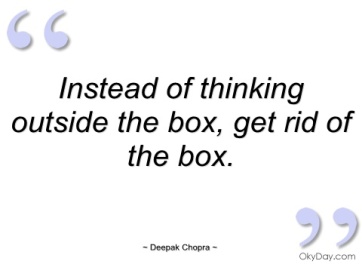
Many people fit in the box. Some people feel boxed-in.

A few people think outside-the-box.

I think about boxes. I build boxes.

I just don’t “fit in” the box.

Maybe you are aware of my previous boxes.

Perhaps you noticed my newboxes”?

Creative Coaching is my FAVORITE un-box.

Thinking outside the box by Crystal124 

← Back

Thank you for your response. ✨


Do you want to go outside your “inner-box” and discover the life you were designed to live?

Fostering Creativity #2

Promoting intrinsic motivation and problem solving are two areas where educators can foster creativity in students. Students are more creative when they see a task as intrinsically motivating, valued for its own sake.

Creativity... #problemsolving #creativity

To promote creative thinking, educators need to identify what motivates their students and structure teaching around it. Providing students with a choice of activities to complete allows them to become more intrinsically motivated and therefore creative in completing activities or tasks.

Teaching students to solve problems that do not have well defined answers is another way to foster their creativity. This is accomplished by allowing students to explore problems and redefine them, possibly drawing on knowledge that at first may seem unrelated to the problem in order to solve it.

Fostering Creativity #1

The conventional system of schooling is sometimes seen as “stifling” of creativity. The pre-school, kindergarten and early school years are often the only ages where there is an attempt to provide a creativity-friendly, rich, imagination-fostering environment for young children.

Researchers see the importance of fostering creativity because technology is advancing our society at an unprecedented rate. Creative problem solving will be needed to cope with challenges as they arise. Creativity also helps students identify problems where others have failed to do so, in order to discover a solution.

Capture Creativity #2

People who are serious about exploring their creative side develop and practice various methods of capturing new ideas. Artists carry sketchpads. Writers and advertisers carry notepads or pocket computers. Inventors make notes on napkins and candy-bar wrappers – especially inventors of new foods!

With new creative abilities people are also better able to solve even every day problems. Everyone can develop some type of creativity, and with more creativity, people experience greater happiness. The creative process is itself a source of joy for most people.


simple-ideas-to-stimulate-creativity